The luxury retail environment has to reflect and reinforce the brand, providing customers with immediate purchase validation, and the fitout, as a physical representation of the brand, is vital to it. It’s where bespoke joinery makes the difference between displaying a product and showcasing a high-end object of desire.
Yet it’s more than showcasing high-end objects. It’s about elevating the customer experience to the point where shoppers feel special. The luxury difference should be evident from the level of service and fitout finishes that, flawlessly presented, become a tangible tool to help gently nudge the customer towards a purchase decision.
It’s not just about looking more upmarket. The difference between regular retail fitouts and luxury fitouts goes beyond upgrading from plastic to wood. The purpose is to create a feeling of exclusivity that's imbibed by customers so they feel calm and relaxed, to the point where they’re more receptive to the highly-trained sales staff.
The fitout supports the luxury perception of the product. In fact, such is the correlation between the quality of fitout and the perceived quality of the product, that even if a luxury brand is known to the customer, if the fitout is poor it will serve to undermine their perception, negatively impacting their views on product quality.
This may sound a little far-fetched if you’ve not set foot in a luxury retail environment for some time, so think about the last iphone you purchased (sorry Android users). Apple uses controlled friction to create that ‘slow slide’ or ‘float down’ effect experienced when opening the box lid. That’s not all though. They also use an air vacuum by making sure the box has an incredibly tight tolerance between lid and base. Together, it makes unboxing an iPhone an experience in itself, reinforcing the premium price point. A luxury retail fitout seeks to do the same thing. Just on a much bigger scale.
Here’s what a luxury fitout needs to do:
Doing this is made easier with bespoke joinery, often blending flawless finishes with hidden functionality so the fitout becomes an exercise of form over function.
In the luxury retail environment, every aspect of the fitout needs to add to the brand experience. The counters, cabinet and consultation desks all need to project the same quality as the products. If doors can be opened, drawers slid, and display units unlocked, they have to do so with all the quiet elegance and smoothness of the Apple box.
Moving beyond looks and functionality, the joinery quality should also be felt by the customer. When they place their hands on the consultation desk it has to feel expensive. Real wood that tacitly communicates luxury. A finish that exudes refinement. It all helps build the sense of exclusivity that separates luxury retail from regular shops.
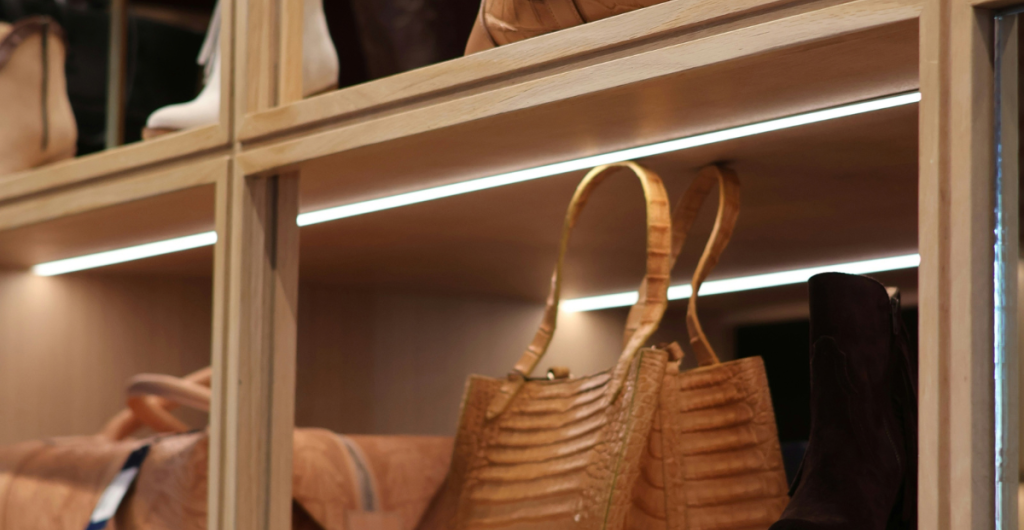
Material selection is critical here. Certain types of wood work better than others when paired with other materials (i.e stone, brass, leather) and the right wood finish will compliment any brand textures and the brand palette, elevating the fitout to a level that is sensed by customers. It’s all about creating the right brand atmosphere, with the joinery combining with lighting and other materials to create a sense of place that’s unique to the brand.
For example, lighting and joinery combined will influence the mood of the shopper and direct attention to where it’s needed. Ambient lighting slows the shopper down and relaxes them, then accent lighting on the product draws their attention so, together, they create and direct shopper focus to where the retailer wants it.
There’s no single study to establish a direct correlation between fitout standards and consumer spend. However, there’s more than enough research to be confident that, while unquantifiable, there is a definite link between the retail environment and consumer spend.
For example, the Mehrabian-Russell environmental psychology model detailed in ‘An Approach to Environmental Psychology’ (1974) explains how the physical environment influences human emotion and behaviour. In essence, shoppers react to the physical environment and a luxury fitout is designed to elicit a known emotional response. The lighting, spatial layout, scents, staff presentation, and the joinery, all contribute to a specific atmosphere. That atmosphere then triggers an emotional response in the consumer. In this case, the consumer takes pleasure from the atmosphere, may find it calming, and will derive a feeling of control and status from simply being there. These emotions then trigger behaviours, such as increasing the dwell time, a willingness to pay a premium (the atmosphere communicates value - in the case of luxury, it says ‘this product is worth more’), and a higher chance of return, because we like to do things that bring pleasure more than once.
It’s these behaviours we know can increase sales. Taking dwell time, there’s a clearly established link between dwell time and propensity to purchase, with a 1% increase in dwell time leading to a 1.3% increase in sales (‘Retail Dwell Time – the Route to Higher Spending’ by Path Intelligence and MIT). Other studies confirm much the same, showing a trend whereby the more time an individual spends in a shop, the more they spend. Yes - this is why we need to usher children out of the toy store as quickly as possible.
Less academic but just as useful are the real world actions of leading luxury brands. The 2025 Bain-Altagamma Luxury Goods Worldwide Market Study is an annual benchmarking report that draws from real-life examples to support conclusions and recommendations. The report argues that brands must move their strategy towards ‘experiential indulgence’, which supports the aforementioned need to create a pleasurable atmosphere. Backing this up is their research showing 70% of luxury shoppers are dissatisfied with their in-store experience, while 90% found one brand experience indistinguishable from another. This perfectly shows the user-case for a fully realised luxury fitout using bespoke joinery - because the opportunity to stand out is waiting to be exploited.
What all of the above does is this - it proves a luxury fitout can lead to increased spend while acting as a differentiator versus brand competitors. And we know that brand differentiation (or distinctiveness as is really the case here) is well-documented as a catalyst for brand growth.
It all means investing in a luxury fitout is a wise investment, as backed by science and research. And us.