Great joinery will have both a form and function to fit its immediate environment. It cannot look out of place, nor can it feel out of place. This is especially true when that immediate environment is a hospital or a medical services setting. Patient care is the obvious priority. What isn’t as obvious is how the joinery adapts to the setting and is used to enhance both the patient and practitioner experience.
Joinery in healthcare settings must first adhere to the NZ Building Code (NZBC) and then satisfy the requirements of Health NZ’s National Facility Design.
The various elements of the code address areas such as structural stability and durability, design for access and mobility, seismic performance, and more. There’s nothing special about these Code Standards insomuch as they’re not specific to the healthcare environment. That guidance comes from the Health NZ Design Standards, which is largely derived from the Australasian Health Facility Guidelines (AusHFG). The AusHFG has specific parts that address joinery, such as ‘Part D - Infection Prevention & Control’ which sets the requirements for benches and cupboards, detailing the need for impervious/washable surfaces.
Generally speaking, joinery in a patient care area should be smooth, free from moisture retention, and designed for minimal dust accumulation. It should be impervious and easily washable. This means there should be no exposed or unsealed joinery elements, and it should be sealed, laminated or veneer-finished. The overriding principle is as you’d expect - joinery must actively prevent bacteria growth.
There’s another consideration, which sometimes gets overlooked. Joinery in healthcare undergoes frequent cleaning using products that would degrade standard joinery, so it has to be crafted to meet the demands of the environment and built to last. This is also important considering the need to maximise return on investment in any healthcare setting given budgets are often spread thin.
Interestingly, meeting AusHFG is more voluntary than compulsory. There’s no real imperative to do so. Although we’d suggest doing what’s best for the patients is imperative enough.
The focus of healthcare design was traditionally concerned exclusively with sterility and the creation of an environment that could fight contaminants, germs and other nasties. This led to facilities which were considered cold and unpleasant and resulted in anxiety-inducing spaces, increasing stress levels in patients and inhibiting recovery.
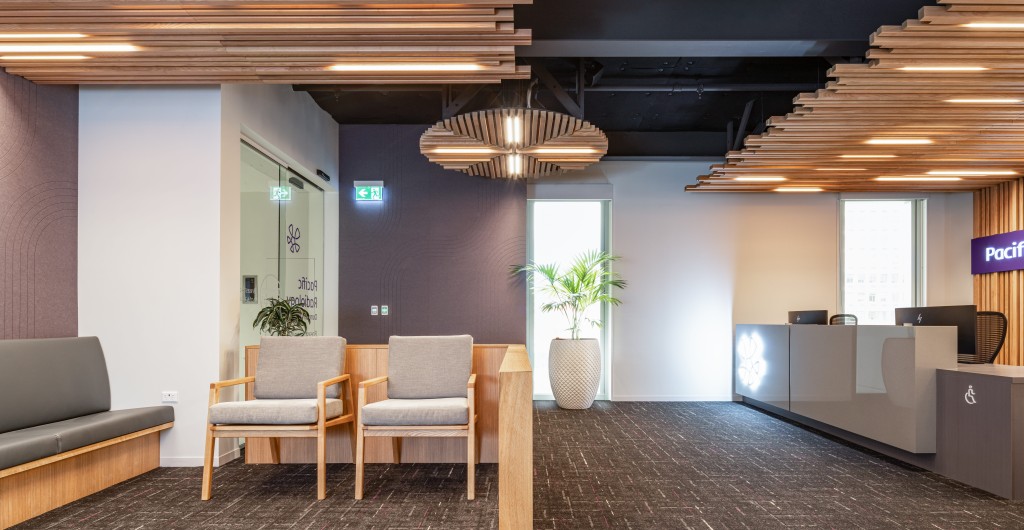
We now have a better understanding of the need for healthcare settings to provide psychological comfort and joinery plays a significant role in meeting this need. The introduction of natural elements and bringing nature inside, known as Biophilic Design, is proven to boost patient comfort ratings and aid recovery. In a waiting room or consult room the joinery can help calm and put the patients at ease, the idea being that such elements provide a relief from the purpose of being there. This builds on the Attention Restoration Theory developed by Rachel and Stephen Kaplan, which explains how looking at natural elements help people recover from mental fatigue.
In short, there’s something restorative about wooden joinery and patients benefit from healthcare settings that use it.
Patients will also benefit from joinery that’s designed for them. There is no one-size-fits-all solution because different healthcare facilities cater to different healthcare needs.
For example, patients with dementia or cognitive decline benefit from spaces which feel safe and familiar. The aesthetic has to feel as much like-home as possible, with joinery that’s instantly recognisable for what it is (minimal minimalism please). The same goes for joinery in aged-care, where recognisability is as important as cleanability. This is because patients with dementia and the elderly (not always, but often) have a reduced ability to make sense of unfamiliar surroundings.
Yet Joinery in pediatric areas might hide those tactile elements, so drawers and cupboards can’t be opened to reveal scary medical equipment. And the shape and colour of joinery should be more playful, taking on an appearance that’s not unlike an Early Learning Centre, so children feel calmer and more at home.
Joinery in mental healthcare settings is different yet again. The priority is safety and joinery needs to be smooth and curved so patients cannot harm themselves, nor should any part of joinery be able to be used as a weapon, meaning spaces are made tamper-resistent.
The overriding principle with all the above is to be cognisant of how joinery interacts with the patient, both mentally and physically. As private healthcare and private medical facilities continue to grow the joinery becomes an area where they can really elevate the patient experience and offer more.
Working in healthcare often means working long hours in a high pressure environment. We’re limited as to how much we can help these wonderful individuals, but we can help make the day a little easier with joinery that works with them and not against them.
For example, making sure nurse stations and desks are designed ergonomically to lessen the threat of cumulative injury risk. And cupboards and storage areas should be designed around the clinical workflow so they help reduce cognitive load. This may not sound like much but we know it makes a real difference and helps the practitioner remain focused on what they need to do - which is to practice medicine.
The differences well-thought out joinery can make to the practitioner's experience should not be underestimated and in an area where incremental gains yield substantial results, it becomes critical. This is also why it’s important to engage with a commercial joiner with prior experience in healthcare. We’re able to offer advice and guidance, and help improve outcomes for everyone.
Indeed, when it comes to healthcare everyone wants the best. That doesn’t mean the most expensive. Rather, it means that every aspect of the healthcare journey supports the best outcome. Joinery can make a real difference here and we’d be happy to talk more about this if you have any questions or a project to discuss.