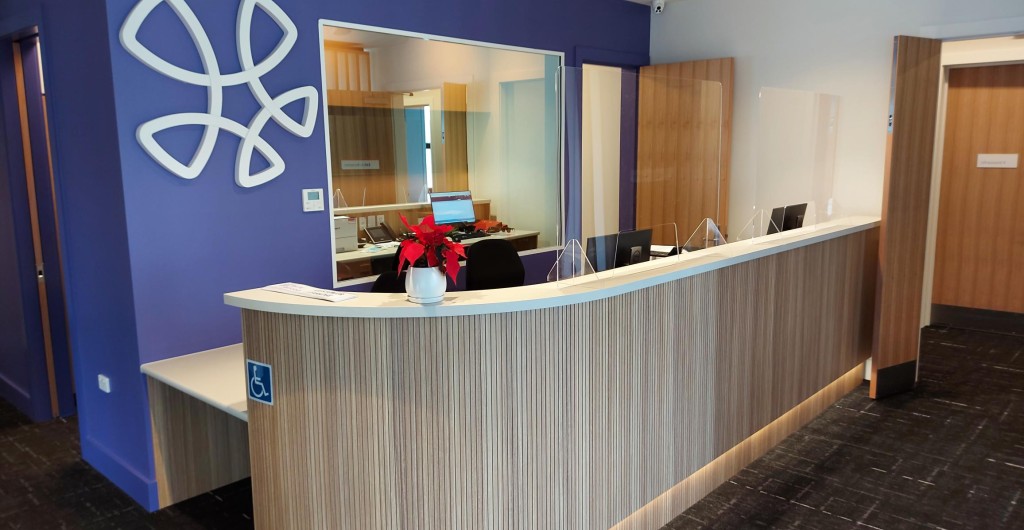
The reception desk at the Southern Cross Hospital in Queenstown shows off the use of timber and features a gentle curve. This is not accidental. The warmth of wood is known to relax and the curves are calming and comforting. The design was intended to help put patients and visitors at ease, and it works, using a height that whilst never imposing, is sufficient enough to largely remove the computer screens and technology used by the receptionists from plain sight.
Everything is intended to communicate a sense of serenity and calm and it begins with the reception desk, knowing eager eyes will always travel their first, as the visitor experience begins in earnest. But just how and why does the reception desk hold such an important place in the psyche of a visitor? And how can design be used to influence the visitors feelings towards the establishment they now find themselves in?
The Importance of First Impressions
The old adage of ‘you never get a second chance to make a first impression’ (generally attributed to Oscar Wilde) does hold water. We know from the Serial Positioning Effect that a person's attention and ability for recall is highest towards the beginning and the end of an interaction. To that end, the reception desk becomes important as it’s fundamental to a visitor who is forming their first impressions. Whether they know it or not, that reception desk is colouring how they feel about the business/service they are visiting.
For example, if the reception desk reflects the colours and graphical elements of the business’s brand identity, then it can help let visitors know they’re in the right place, put them at ease, and promote the perception of professionalism. Conversely, if the reception desk is actually a seeming hodgepodge of mixed and ill-fitting parts, it’ll sow seeds of distrust and doubt, pointing towards a chaotic business and experience to follow.
The take-home message here is that first impressions really are vital and the reception desk plays an important role in setting the tone for the visitor experience to follow.
Brand Identity, Shapes, and Choosing Colours
Circling back to the use of branding, the reception desk can be used to reaffirm the brand identity, where it can begin the process of building brand loyalty. It does that here by providing a clear mental trigger of a brand interaction which can help boost the mental availability of the brand. Research shows a brand's growth is partially dependent upon this mental availability (essentially the ability to recall the brand), providing a good reason to make sure the reception desk design is used to reaffirm the brand identity. Unless the reception desk is for multiple businesses and doesn’t have to abide by a brand palette, then the design and use of colour can be more diverse.
When it comes to the shape of reception desks, there’s more than a few functional restraints and the expected rectangular presence of a reception desk is expected for a reason. Yet that doesn’t mean it has to be. The aforementioned curves of the Southern Cross reception desk introduce the intended sense of calm and also help define a larger workable space behind the desk. That said, these changes are subtle and it’s unlikely a star shaped reception desk will ever be called for.
Of course, shapes carved into or fixed to the reception desk is a different matter. Here, shape psychology will then play a role. Triangles are seen as edgy and defiant. Circles are accepting and friendly, while squares (and rectangles) are strong, professional and efficient. A design using horizontal lines is seen as relaxing while vertical lines are aggressive and overtly masculine.
Then there’s colours. These have always had an enormous impact upon us and the reason so many fast food outlets use red is because it’s known as the hungry colour, stimulating appetites. Yellow is generally associated with cowardice (‘yellow-belly’), green with envy and ambition, while blue is known to promote a feeling of security (which is why banks use it a lot).
Reception Desk Dimensions
The overall dimensions of the desk will communicate a message to the visitor. An oversized desk, with an imposing height and expansive length creates a barrier that can make visitors feel nervous. Of course, if the building houses an intelligence agency then a reception desk with an intimidating presence isn’t a bad thing. To a less flippant example, a large reception desk for a business involved in providing some kind of security will communicate that they take their role seriously and can be trusted.
The other end of the spectrum is a low-rise reception desk that breaks down the barrier between the receptionist and the visitor. This is seen as being more welcoming and approachable, especially if used in conjunction with other reception area furniture and soft furnishings, where it places everyone at the same level, creating an environment more akin to a home setting.
Functional Considerations
There’s always practical design constraints and reception desks are no different. For example, the use of technology will impact the design and should a business use some kind of touchscreen check-in process or tablet-based information resource, the reception desk design should ideally incorporate this. Interestingly, while technology can be used to help streamline check-in (in the case of hotels) and aid other functions, it can be questioned whether its purpose is to help the visitor or the business. Does being told to read what’s on the screen and then ‘sign’ come across as more or less welcoming than the receptionist explaining and then asking the visitor to sign?
All the above adds weight to the importance of the reception desk as a key waypoint in the visitor experience and the need to understand the psychological impact it has on visitors. Once that psychology is understood, it can be managed. But why?
The importance of doing so was demonstrated in a thesis by J. Park at Florida State University. This research showed how a reception desk acts as a psychological interface between the organization and visitors, and can impact whether they want to return (for pleasure or for work). Central to the research are the concepts of ‘Consideration’ and ‘Control’. These psychological dimensions can be used to articulate the experience an organisation wants the visitor to have.
Consideration is about warmth and welcoming visitors. A reception desk that’s visually lighter, less imposing and seamlessly integrated into a space, signals to the visitor that they’re valued and respected. In contract, control is all about authority and formality, using large reception desks that create a barrier. A bit like the multiple desks at immigration, typified by having the immigration officer in a raised seat (or platform) and a higher than usual desk/counter, so visitors have to look up and are placed in a position of subservience.
The research was able to demonstrate how the reception desk impacted the visitor experience by measuring whether a respondent would like to work at the organisation or not, thus proving the importance of reception desk design.
What does this all mean? It means the reception desk is a critical part of the visitor experience and that experience needs to be crafted just as carefully as the desk itself.
And we can help you by crafting that reception desk if you like.