New Zealand welcomes over 3.5 million international visitors annually. It’s a quite remarkable number given how far removed we are from much of the world, but for many, NZ remains a once-in-a-lifetime destination. The NZ tourism industry comprises an estimated 40,000 operators. Competition is fierce, and many activities and attractions succeed or fail by their online reviews and ranking. It only takes one bad TripAdvisor review to undo the good work from five positive reviews, and often it’s not because something significant went wrong; it’s merely because there’s a tendency from those who post reviews to naturally skew towards either end of the spectrum. In other words, there’s often no balancing middle ground, and reviews are either good or bad.
It’s a perilous position, and it requires tourism operators to remove all doubt from the visitor experience. This includes making sure the joinery helps shape the ‘servicescape’ and how visitors respond to it. We’re not saying joinery will lead to increased visitor satisfaction. But we are saying the right joinery plays a role and, in an industry where the margins for error are slim, that role is important.
Servicescapes and Visitor Satisfaction
The term ‘Servicescape’ was coined by Mary Jo Bitner in 1992 to describe the physical environment in which a service is delivered and experienced, referring only to the man-made setting and not the natural one. For a tourism operator, it’s the constructed environment where employees service visitors. So think of check-in areas, welcome desks, waiting areas, and such. They all build the servicescape for the operator and, as such, impact levels of satisfaction.
Bitner’s research and hypothesis (‘Servicescapes: The Impact of Physical Surroundings on Customers and Employees’) takes the position that the physical surroundings are more important in service settings because customers' and employees' experiences are largely impacted by them. This makes sense: visit a world-class tourism attraction like Skyline Queenstown and the experience begins at the bottom terminal (more on this soon). Critically, it’s the moment the experience begins that satisfaction scores start being summed up in the visitor's mind. It’s no different from visiting a fine dining establishment for the first time, looking around, and then thinking to yourself, ‘well, this is all rather pleasant’. In your mind, you’ve begun ranking the experience already.
What’s happening is that the perception of the servicescape is leading to positive (or negative) beliefs and attributions associated with the tourism operator and its staff. These perceptions then influence how visitors categorise the operator according to their own levels of satisfaction.
This all sounds a little theoretical, so we should apply it to the previously mentioned Skyline Queenstown. Also, let's join the dots to the joinery at the same time.
Skyline Queenstown underwent a $250 million redevelopment, adding new gondolas and terminals at the top and bottom to service them. The base terminal is where the visitor satisfaction scoring begins, arguably playing an overweighted role given the importance of first impressions. It was literally ground zero for the 1.5 million visitors in FY 25/26 (Skyline Annual Report 2026). When visitors first walk inside, the focal point is naturally the ticketing booth. Only it’s not a booth in the traditional sense. It’s a very carefully crafted outline of a gondola cabin featuring integrated lighting and upbeat colours that warm the audience for the fun to follow.
What the booth we crafted does is set the scene and start the visitor journey the right way. It communicates ‘we’ve thought about this and care’. Importantly, it does this precisely when the visitor experience is at a critical point - namely, payment. Just as importantly, Skyline Queenstown didn’t settle for a fiberglass or cheap-looking gondola frame. They chose bespoke joinery at a point in the journey when it can validate the purchase decision. That’s actually really, really clever.
Joinery and the Perception of Value
Another example of a servicescape having a positive impact on visitor satisfaction is Coronet Ridge Resort. Winner of the Boutique Hotel Award (2026 HM Aotearoa-Pacific Awards) and Hotel of the Year - Refurbishment (2026 Australasia Pacific HM Hotel Design Awards), the luxury accommodation currently enjoys a 5-star rating on TripAdvisor and is a Travellers Choice ‘Best of the Best’ Award winner, placing it in the top 1% of hotels globally.
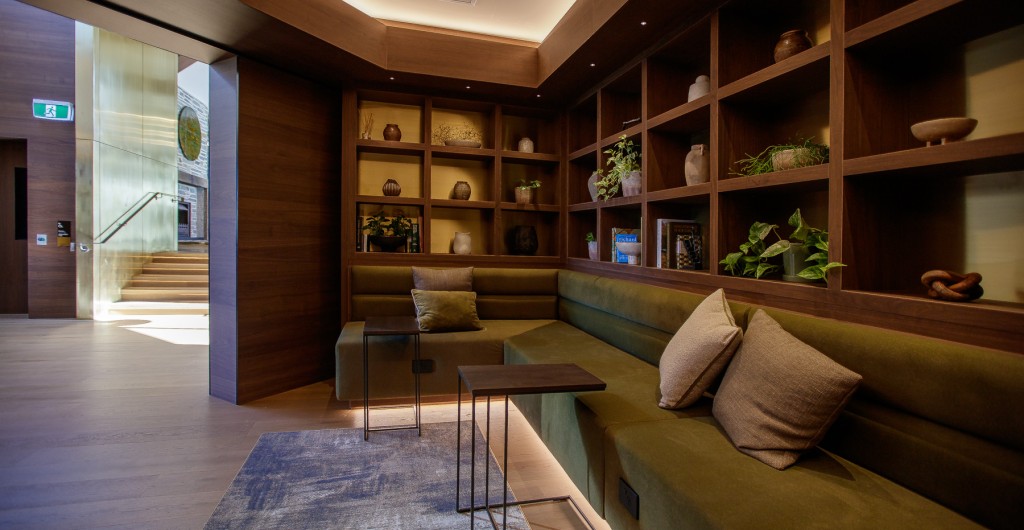
Inside, the warm and welcoming upmarket aesthetic is created by the extensive use of wood. Our work extends to the entry bookshelves, banquette seating, tables, planters, upholstered wall panelling and cabinetry, finished in the natural grandeur of darker wood in relaxing areas, and lighter wood in areas of movement and energy.
What the abundance of wood does is create a feeling of luxury. It relaxes the visitor, including their grip on the travel budget. In ‘The Perception and Performance of wood in relation to Tourist Experience (Kotradyova, V & Vavrinky, E. 2025) researchers found 58% of respondents would pay more should the setting use natural materials such as wood.
Of course, in the case of Coronet Ridge, bookings are made in advance, but what the wood does here is to validate their accommodation decision. This can be linked to the ‘Illusion of Effort’, whereby perceived effort is seen more favourably and has a value attached to it. Let’s use the words being typed here to explain, because this is important. If you thought these words were generated by AI, then you’d attach less importance to them because the assumption is that minimal effort has been used. So you’ll think they’re less worthy. Evidence for this comes from a 2023 study led by Kobe Millet from Vrije Universiteit Amsterdam. The study showed 800 people a picture of a human skill, labelled as either human-made or AI-generated. Respondents were asked how likely they were to purchase the drawing on a scale from 1-7. Those seeing the drawing labelled as human-made were 61% more likely to purchase it than those seeing the drawing labelled AI-generated. The reason why is because value is linked to effort, so servicescapes such as Coronet Ridge, who have clearly gone to great effort to create a memorable environment, are viewed more favourably. This carries through to visitor satisfaction levels.
Skyline Queenstown and Coronet Ridge are two examples of tourism operators who have worked hard at every little thing in pursuit of visitor satisfaction, and it shows in their success. We know joinery is only one facet amongst many, but we like to think the role quality joinery plays is significant.
Not convinced? We’d be happy to explain in more detail if you have a project to discuss. You can contact us by email at sales@poolesjoinery.co.nz or by calling 03 215 9167.